Read the policies, reports, and plans on how we address issues like racism and reduce our carbon footprint, ensuring our actions align with the highest ethical standards.
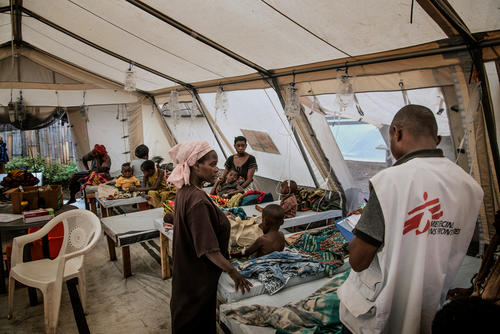
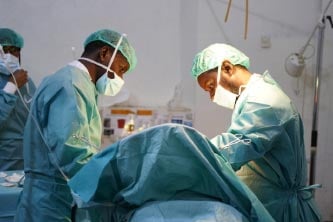
In more than 70 countries, Médecins Sans Frontières provides medical humanitarian assistance to save lives and ease the suffering of people in crisis situations.
We set up the MEDSF Access Campaign in 1999 to push for access to, and the development of, life-saving and life-prolonging medicines, diagnostic tests and vaccines for people in our programmes and beyond.
Based in Paris, CRASH conducts and directs studies and analysis of MEDSF actions. They participate in internal training sessions and assessment missions in the field.
Based in Geneva, UREPH (or Research Unit) aims to improve the way MEDSF projects are implemented in the field and to participate in critical thinking on humanitarian and medical action.
Based in Brussels, MEDSF Analysis intends to stimulate reflection and debate on humanitarian topics organised around the themes of migration, refugees, aid access, health policy and the environment in which aid operates.
This logistical and supply centre in Brussels provides storage of and delivers medical equipment, logistics and drugs for international purchases for MEDSF missions.
This supply and logistics centre in Bordeaux, France, provides warehousing and delivery of medical equipment, logistics and drugs for international purchases for MEDSF missions.
This logistical centre in Amsterdam purchases, tests, and stores equipment including vehicles, communications material, power supplies, water-processing facilities and nutritional supplements.
BRAMU specialises in neglected tropical diseases, such as dengue and Chagas, and other infectious diseases. This medical unit is based in Rio de Janeiro, Brazil.
Our medical guidelines are based on scientific data collected from MEDSF’s experiences, the World Health Organization (WHO), other renowned international medical institutions, and medical and scientific journals.
Providing epidemiological expertise to underpin our operations, conducting research and training to support our goal of providing medical aid in areas where people are affected by conflict, epidemics, disasters, or excluded from health care.
Evaluation Units have been established in Vienna, Stockholm, and Paris, assessing the potential and limitations of medical humanitarian action, thereby enhancing the effectiveness of our medical humanitarian work.
MEDSF works with LGBTQI+ populations in many settings over the last 25-30 years. LGBTQI+ people face healthcare disparities with limited access to care and higher disease rates than the general population.
The Luxembourg Operational Research (LuxOR) unit coordinates field research projects and operational research training, and provides support for documentation activities and routine data collection.
The MEDSF Paediatric Days is an event for paediatric field staff, policy makers and academia to exchange ideas, align efforts, inspire and share frontline research to advance urgent paediatric issues of direct concern for the humanitarian field.
The MEDSF Foundation aims to create a fertile arena for logistics and medical knowledge-sharing to meet the needs of MEDSF and the humanitarian sector as a whole.
A collaborative, patients’ needs-driven, non-profit drug research and development organisation that is developing new treatments for neglected diseases, founded in 2003 by seven organisations from around the world.
Noma is a preventable and treatable neglected disease, but 90 per cent of people will die within the first two weeks of infection if they do not receive treatment.