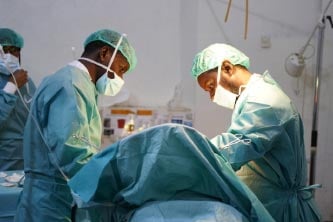
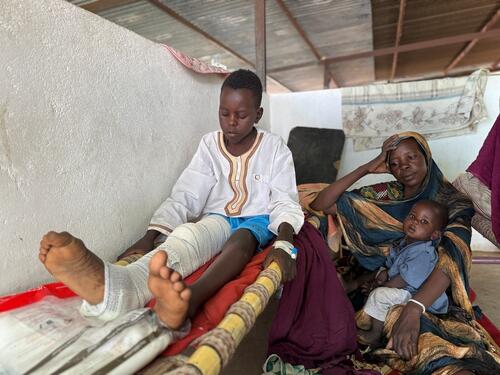
Port Sudan – Following a series of attacks by the Rapid Support Forces (RSF) and the Sudanese Armed Forces (SAF), 99 wounded patients, including women and children, arrived at Médecins Sans Frontières-supported health facilities across North, Central, and South Darfur in Sudan, on 10 September. Four people across the facilities were declared dead on arrival.
“We urge all warring parties to immediately spare civilians, protect medical staff and facilities, and guarantee safe, unhindered access for humanitarian aid, starting in El Fasher and other besieged areas,” says Marwan Taher, MEDSF Head of Mission in Darfur. “The humanitarian crisis is spiralling, and the world cannot continue to look away.”
In Tawila, North Darfur, MEDSF staff treated 50 wounded patients yesterday alone. Over 650 injured people, who have managed to escape from El Fasher, have arrived at the MEDSF-supported hospital located 60 kilometres away from the besieged city since mid-August. This represents just a fraction of the casualties, as survivors have described seeing many dead bodies on the roads and having to leave behind the most critically sick and wounded, people who simply wouldn’t have survived the journey to Tawila.
“Some people have walked 60 kilometres on foot, bleeding from gunshot wounds and severe whippings, yet they are the fortunate few who survived the horrors of El Fasher and the journey to escape it,” says Sylvain Penicaud, MEDSF project Coordinator in Tawila. “They arrive exhausted, broken, and in such extreme states of distress.”
We urge all warring parties to immediately spare civilians, protect medical staff and facilities, and guarantee safe, unhindered access for humanitarian aid.Marwan Taher, MEDSF Head of Mission in Darfur
People also explain how life has become unbearable in and around El Fasher. The RSF and its allies have besieged and bombed the town for over a year, leaving hundreds of thousands of people trapped, with virtually no food, medicines, water or humanitarian aid. People attempting to escape El Fasher face killings, torture, sexual assault and other extreme forms of violence along the route to Tawila, which now hosts 800,000 internally displaced people.
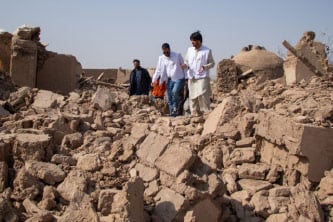
As Sudan’s war continues in its third year, people face relentless violence with nowhere to flee. On 10 September, drones struck multiple locations across Darfur, leaving hundreds of people injured. Even communities far from the frontlines are not safe, as attacks escalate simultaneously across the region.
A SAF drone strike landed just four kilometres from the MEDSF-supported Zalingei Teaching hospital in Central Darfur, the first one since February.
“From the hospital, our teams heard the drone strike,” says Taher. “Moments later, in broad daylight, we had to activate our mass casualty plan as an influx of war-wounded people arrived, including six women and four children. No one is safe.”
From the hospital, our teams heard the drone strike... No one is safe.Marwan Taher, MEDSF Head of Mission in Darfur
On the same day, in Nyala, South Darfur, two SAF drones struck the city. Nyala Teaching hospital, supported by MEDSF, received 12 patients; four people, including one child, were dead on arrival. This was the eighth deadly drone strike on the city in just 11 days, following attacks on 30 August and 1 and 3 September, when the hospital treated 44 war-wounded patients.
The situation in Darfur remains dire, with health facilities under extreme pressure and struggling to cope with massive influxes of patients, severe shortages of supplies, and the constant threat of further attacks.
These simultaneous attacks came just a day after RSF airstrikes hit Khartoum, the Sudanese capital, on 9 September, with shrapnel wounding two people who arrived at the MEDSF-supported Al-Nao hospital in Omdurman. The same airstrikes also took out a power station, plunging parts of the city into blackout and forcing the MEDSF-supported Al-Nao and Al-Buluk Paediatric hospitals to rely on generators or unreliable electricity sources. Without stable electricity, lifesaving medical equipment and air conditioning fail, leaving premature and critically ill children dangerously exposed to overheating, infection, and equipment malfunctions.